
Learning for Life
Written by Carmen Kuntz • August 18, 2026
What happens after the learning experience ends? What remains when the worksheet is completed, the assignment submitted, or, in the case of Little Planet, when students return home from the trip? In a time when education is increasingly being asked to prepare students for a complex and changing world, we must ask ourselves: what are we truly trying to achieve through learning?
Think back to a school trip that has stayed with you long after you returned home. What made it memorable? Was it the location, the people, the challenges, activities or opportunities for exploration? Beneath those memories lies a deeper question: what learning was woven into the experience that shaped how you thought, acted and approached the world from that point forward? The most valuable lessons are rarely the ones students remember only long enough to pass a test. They are the ones that resurface months or years later – when a student encounters a new challenge, navigates uncertainty, or finds a creative way forward.
For educator and author Julie Stern, this ability to transfer learning beyond the original experience and apply it in another context, to recognise common threads and a range of applications is the true measure of educational success. As schools are required to move beyond a narrow focus on performance and toward deeper engagement with ideas, experiences, and reflection, learning transfer has become central to understanding how knowledge becomes something students can actually use.
In her extensive work on learning transfer, Stern often returns to a deceptively simple question: what happens after the learning experience ends? What remains when the worksheet is completed, the assignment submitted, or the trip comes to an end?
For Stern – who sat down with Little Planet to talk about learning transfer in outdoor education – the answer lies not in what students can recall immediately after learning, but in what they are able to carry forward and apply in new situations. Stern's career began in experiential education, using Washington D.C. as a living classroom for adolescents. Since then, she has become a leading voice in educational research, authoring multiple books that bridge cognitive science and classroom practice. Throughout her work, one idea remains central: learning only becomes meaningful when it transfers beyond its original context.
Her experience and perspective challenges what education is designed to achieve. Traditional measures of success often focus on outputs like completed assignments, test scores, or grades. Transferable learning, by contrast, asks a different question: what knowledge, habits, and ways of thinking endure long after the experience itself has ended? As we examine Stern’s work, we see examples of enduring learning throughout outdoor education. Looking closely at a Little Planet program through the lens of learning that transfers, it becomes clear that opportunities for students to develop lasting knowledge, skills, and ways of thinking are embedded throughout the experience and extend long after the program itself.
Transferable Learning in Practice
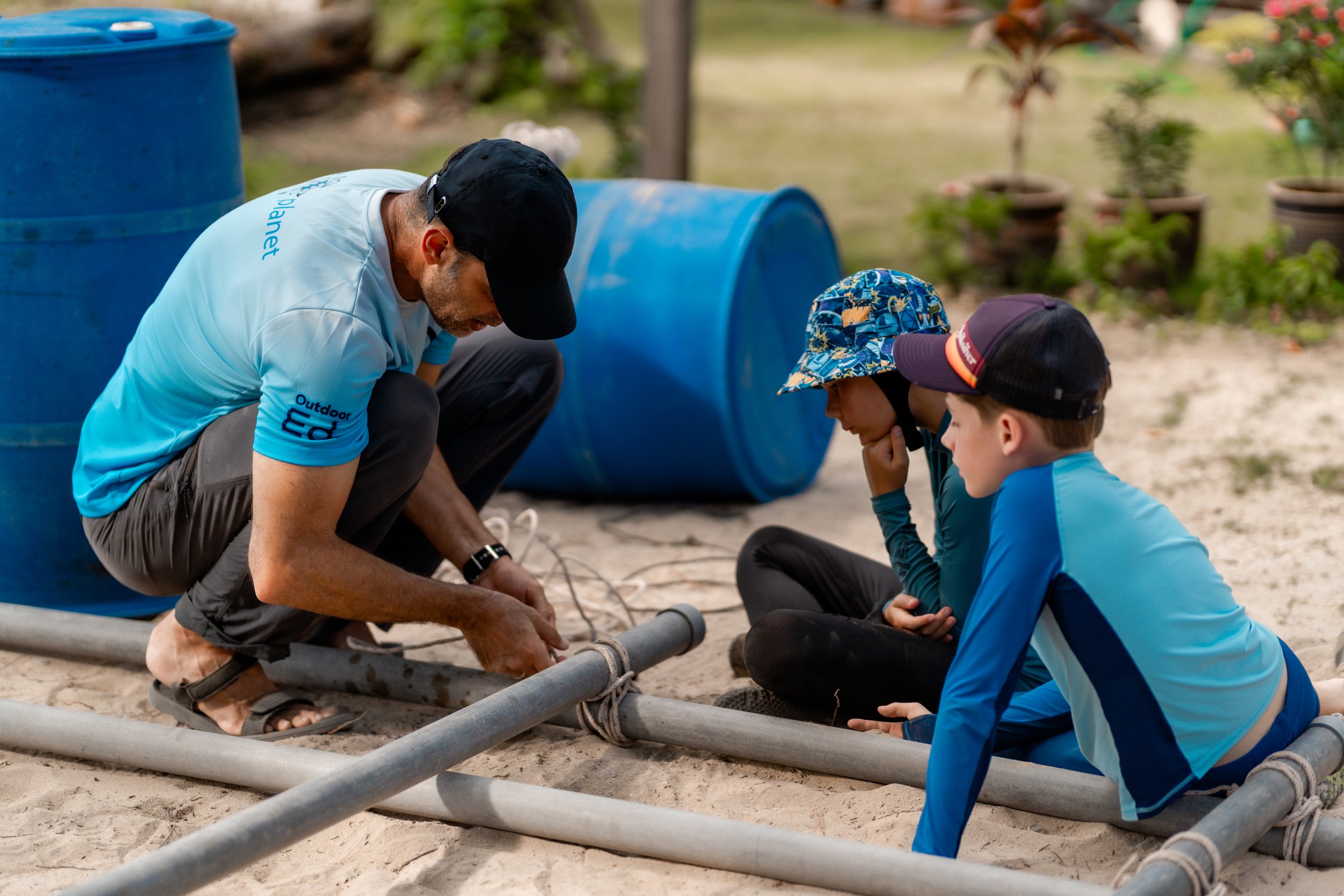
Traditional schooling models often create an environment where students excel at mimicry but struggle to apply what they are learning to the world around them. Outdoor experiential education however, can offer a critical alternative, providing a landscape where the central question shifts from what a student can complete to what a student carries with them after they leave. This philosophy is utilized by Little Planet through adventurous, place-based curriculum design that exposes participants to managed risk, pushing personal boundaries to build resilience, creative problem-solving, and critical thinking. The magic here is that the learning is tangible, it has to be applied and the outcomes are real.In a world increasingly shaped by convenience, instant gratification, and automation , many young people have limited opportunities to practice responsibility and experience independence. At Little Planet, transferable learning is woven into everyday life. Students are expected to manage their own belongings, maintain personal hygiene, keep shared spaces tidy, and take responsibility for their role within the group. While these tasks may appear simple, they require planning, accountability, self-awareness, and follow-through – skills that transfer directly into life back home and beyond.
To guide this developmental journey, Little Planet frames its core learning outcomes around the "4Cs."
Simultaneously, the camp experience serves as a powerful microcosm for human and peer interaction. Removed from familiar home routines, students must develop independence, practice crucial life-skills, navigate group dynamics, and work on self-confidence. To guide this developmental journey, Little Planet frames its core learning outcomes around the "4Cs." This begins with being CREATIVE, which involves activating innovative problem-solving and adaptive thinking under novel conditions. It focuses on being CONNECTED by building an empathetic, systemic understanding of human communities and natural ecosystems. The Little Planet approach emphasizes being CONSCIOUS through cultivating an ethical self-awareness regarding personal footprints and societal choices. And finally, students are - reminded that they are CAPABLE by fostering the practical life skills, independence, and confidence required to execute tasks to meet challenges and become comfortable with struggle.
Living, travelling, and learning alongside others also requires compromise. Students share rooms and expedition spaces, adapt to unfamiliar foods, navigate differences in personality and perspective, and learn how their actions affect those around them. Unlike many classroom exercises, these situations carry immediate consequences. Success depends on being a reliable teammate, showing empathy, communicating effectively, and supporting others when challenges arise. In these settings, when those skills are absent, the group feels it and when they are present, the group thrives.
This framework used by Little Planet aligns with Stern’s core premise that learning is only meaningful if it transfers. In the simplest terms, Stern describes learning that transfers as: “Using a lesson learned in one situation, in a completely new situation.” Her research maps out a spectrum of transfer, ranging from near transfer – such as moving between two similar outdoor education scenarios. To distant transfer, which occurs when young people take insights from one situation (an outdoor or wilderness experience for example) and successfully apply them back home (to complex social dilemmas for example). As explored in our previous article The Power of Place and Why Long-Term Presence & Partnerships Matter More Than Ever, the capacity for distant transfer requires a shift away from rapid, transactional models in favor of sustained, deep engagement. This distinction between task completion and true understanding is central to effective instructional design. As Richard Joyner, Director of Little Planet, notes from a career of global outdoor instruction: “You don’t need a completed worksheet to be successful.”
Outdoor Education as a Catalyst for Transfer
By placing students in dynamic, unfamiliar settings, outdoor education encourages them to adapt, think critically, and approach challenges from new perspectives. Like a well-structured lesson, outdoor education is designed with intentional pathways that lead students toward educationally and personally meaningful experiences. By carefully introducing challenges and opportunities to engage with perceived risk, these environments help students build confidence, resilience, and the ability to overcome obstacles, ultimately setting them up for success in other life experiences. Because these environments rely on more physical learning – where students must do, sense, and interact with a living, unpredictable landscape – knowledge becomes integrated into the learner's identity rather than stored as isolated data. These environments also expose students to forms of discomfort that are increasingly rare in modern life. Whether it is hiking in tropical heat, sleeping in a tent, getting caught in the rain, (or navigating uncertainty without immediate access to technology), students learn that discomfort is not something to be avoided at all costs. Rather, it becomes something that can be managed, understood, and harnessed as an opportunity for growth. This shift in mindset often proves highly transferable, helping young people approach future challenges with greater confidence and resilience.
Stern provided anecdotes drawing an interpretive bridge between the physical experience and cognitive science. “People often think it’s transferable skills, the most common phrase I hear. Yeah sure, they used problem solving or resilience in one situation so they can bring it to another situation,” Stern explains, targeting the pervasive misconception “that only skills transfer and common misconception that it will happen automatically.” School systems frequently struggle to generate deep competence because they assume exposure equals internalization. “We just think it will happen, like if students read a wonderful text – Shakespeare for example – then we assume they are better able to read or analyze another piece or writing,” Stern critiques.
To bridge this gap, Stern believes programs must be structured around deliberate, slow processing. “It’s about intentional reflection. You have to stop and ask, ‘how do these two ideas or experiences interact’. Students need to be able to recognize ‘Here is what happened in my life, here is what I learned.’ This kind of learning is bigger than the situation itself,” she says. This structural reflection is what allows physically immersive environments to catalyze growth. “In the field, learning can easily accelerate, because their senses are heightened. It's novel, and a path that helps them pay attention to what is happening.” However, this sensory heightened state cannot operate in a vacuum and she points out that there needs to be a lot of trust between the guide or teacher and student. And that a lot of learning will take place in the after experience.
Crucially, the timing of these interventions must be appropriate. “Students are not going to be whitewater rafting and reflecting at the same time.” It’s the conversations and questions before and after that produce the real learning moments. In this way, she highlights the need for intentional pacing. “The focus should remain on priming them in advance – so kids can be conscious of the ideas,” says Stern. “This looks like priming them before the exercise and debriefing after.” This builds on the idea that depth and long-term engagement create more meaningful learning experiences and a chance to connect immediate physical sensations to broader, enduring lessons and principals.
From Participation to Transformation and What Students Actually Gain
Moving students from mere participation to personal transformation requires a fundamental shift in how educational success is measured. While participation simply asks a student to show up and execute a task, transformation demands that they internalize the underlying lessons, turning activities into permanent character traits such as adaptability or initiative.
Stern’s writing suggests that transfer is evidenced not in participation, but in changed behaviour in new contexts. She highlights this psychological link between transfer and resilience. “I’m obsessed with discomfort and navigating uncertainty,” she says. “If the goal is to navigate a complex and uncertain situation, then transfer means they can do that by drawing on past experience to figure something out.”
Rather than shielding students from challenges, experiential education uses managed challenges to build capability. “I want kids to be able to think, 'I've never been in this situation but I am a person that can draw on past situations to figure this out,’” she says. This is where experiential education differs from simply providing memorable experiences. The goal is not just to expose students to new places, but to help them develop habits and dispositions that remain useful long after the trip ends. A student who learns to organize their equipment, adapt when plans change, support a struggling teammate, or persevere through discomfort is building capabilities that extend far beyond an outdoor setting.
At Little Planet, these moments occur daily. Students are regularly challenged to step away from screens and familiar routines, engage with uncertainty, and participate fully in the realities of expedition life. Over time, they begin to recognize that they are more capable than they initially believed. This growing sense of competence and self-trust is often one of the most enduring outcomes of the experience.
Case in Practice: Learning In-Place
While strategy and educational frameworks are important, transferable learning is ultimately realized through everyday practices over time. At Little Planet, this philosophy is illustrated through its partnership with the Juara Turtle Project. Staying macro, this real-world learning environment moves past the simple biological facts of conservation and explores how active stewardship of an endangered species prompts or compels students to develop connection, systemic understanding, and environmental responsibility.Through Little Planet’s programs, learning extends beyond environmental stewardship alone. Working within a local conservation initiative exposes students to different cultural perspectives, ways of life, and relationships with the natural world. Through meaningful interactions with local communities and conservation practitioners, students develop greater cultural awareness and sensitivity while learning to recognize common values that transcend geographic and social differences. These experiences encourage a broader perspective on both people and place creating an outcome that transfers well beyond the context of conservation work.
Operating within an authentic environment means students face immediate real-world feedback loops. Stern describes transfer as most powerful when learners encounter real-world consequence systems, and the Juara Turtle Project does just that. This ongoing relationship ensures that student efforts feed into a cumulative, multi-decade conservation effort rather than a fleeting, tokenistic visit.
Why Transferable Learning Strengthens the Curriculum
A recurring theme among educational traditionalists, including many of our students' parents, is the assumption that outdoor experiential programming functions as a supplementary distraction, like a holiday or an escape from the routines of formal education. In reality, experiential learning profoundly enhances the traditional school curriculum by providing a vital, tangible context for abstract theoretical models. By applying academic concepts to real-world situations, students experience increased engagement, deeper conceptual retention, and a renewed interest in classroom material.
This aligns with Stern’s view that transferable learning strengthens retention and meaning-making by helping students apply knowledge across diverse contexts, transforming learning from static information into flexible understanding that can be adapted and used beyond the original learning environment.
Furthermore, a radical change in the learning environment plays a vital role in disrupting deeply entrenched academic and social patterns, breaking down the stigmas and defensive learning behaviors that can paralyze students within traditional school walls. Early in her career, Stern noticed how traditional history curricula frequently locked students into localized details, preventing broader understanding. “Teaching about the American revolution thinking they were making connections to human rights, freedom, justice, power, but they were focused on the details, memorizing specific people, locations and dates.” she reflects. “The learning breakthrough occurs when I disrupt the narrow focus and ask questions like: ‘where can we find these themes today?’ Once I started intentionally asking those questions kids started making connections.”
Intentional Program Structure Designed for Transfer
True learning transfer rarely occurs by accident; it requires intentional instructional design across a learning journey. To maximize the long-term utility of an experience, a program should be structured across three distinct phases:
Pre-Departure Preparation begins long before students arrive on Tioman Island. By introducing key concepts in advance, educators help students arrive ready to engage more deeply with what they encounter with prior knowledge that augments and accelerates the learning experience being built upon a foundation of theory and academic learning. In-Field Facilitation then creates opportunities for challenge, discovery, and adaptation. For Stern, “It has to be a thinking-rich environment.” She cautions that students can still fall into simply “going through the motions,” making high-quality facilitation essential. “An adult that makes thinking and discovery and aha moments fun and cool is the foundation of doing this well,” she explains, emphasizing that learners need to feel supported in an environment where intellectual risk-taking or intellectual integration is valued.
Finally, Post-Experience Reflection helps transform experiences into transferable learning. “I look for familiar structures in the way we reflect and harness the experience,” she says, noting that while it’s hard at first to get a teenager to reflect, transfer develops through the repetition of strategies. The goal is for reflection to become habitual, to the point where students recognize, “Ok, the teacher is going to ask us this question.”
Echoing the importance of reciprocal partnerships and long-term engagement discussed in our previous article, this intentional structure helps ensure experiences move beyond participation and become learning that endures.
Learning That Stays with You
Ultimately, transferable learning is defined as that which remains after the experience has ended. Long after the immediate parameters of the trip or the lesson fade from memory, the expanded capacity for connection and resilience stays with the student. Outdoor education, when executed with planning and intention, creates the precise conditions necessary for this deep, lasting learning to take root. This could include a stronger sense of responsibility, greater resilience, increased independence, deeper empathy, and the confidence to navigate unfamiliar situations. These are not skills only applicable to an outdoor education program, they become accessible tools that influence how young people approach relationships, education, work, and the wider world.
While experiential education has historically been viewed as supplementary or a luxury, Stern encourages a re-evaluation of this type of learning as essential. “Experiencial learning provides such an amazing learning opportunity that has lasting impacts in the classroom because young people learn independently to trust themselves.”
This reinforces the central theme of Little Planet’s broader learning philosophy: slowing down equals deeper learning, which in turn supports greater learning transfer. By resisting the urge to race through a superficial checklist of activities and choosing instead to immerse students deeply in a singular place, their understanding can mature and lessons can settle in. Education is not defined by how many tasks students complete, but by what they are able to carry with them; the knowledge, skills, and confidence to navigate new challenges beyond the classroom. Experiential learning is about preparing students not just for exams, but for an unpredictable future. Stern concludes with a statement on one of the traditional benchmarks of educational success: “Instead of ‘nothing is worth learning if you don’t remember it,’ I would go as far as to say ‘nothing is worth learning if you don’t use it in a future situation.’ That is the point.”